Tubal Ligation Consultation in Seoul Gangnam Y Queen Women's Clinic
Y Queen Women's Clinic provides English-speaking tubal ligation consultations and permanent contraception counseling in Gangnam, Seoul for local and international patients. Tubal ligation is a highly effective, permanent birth control method that prevents pregnancy by blocking, interrupting, or removing the fallopian tubes. Our OB-GYN specialists discuss permanent sterilization, bilateral salpingectomy, potential risks and benefits, reversible contraceptive alternatives, and future reproductive goals before treatment. When surgical care is appropriate, patients can be referred to a suitable hospital or surgical specialist while receiving confidential, personalized, and foreigner-friendly women's healthcare in Seoul.
Tubal Ligation Consultation in Seoul at Gangnam Y Queen Women's Clinic
Tubal ligation is a permanent form of contraception for women who are certain they do not want future pregnancies. Often referred to as having the "tubes tied," the procedure prevents pregnancy by blocking, sealing, cutting, or removing portions of the fallopian tubes so that sperm and egg cannot meet. Because tubal ligation is intended to be permanent, careful counseling and evaluation are important before deciding on the procedure. At Y Queen Women's Clinic in Gangnam, Seoul, we provide confidential contraception counseling and gynecological evaluation for women considering permanent birth control. Our English-speaking women's health team welcomes Korean residents, expats, international residents, business travelers, and medical tourists seeking professional reproductive healthcare in Korea. Our OB-GYN specialists can discuss tubal ligation, its benefits and limitations, reversible contraceptive alternatives, and whether referral to an appropriate surgical facility is needed.
What Is Tubal Ligation?
Tubal ligation is a surgical sterilization procedure designed to permanently prevent pregnancy.
Depending on the surgical technique, the fallopian tubes may be:
- Sealed
- Cut and closed
- Blocked
- Partially removed
- Completely removed (bilateral salpingectomy)
These procedures prevent an egg and sperm from meeting and therefore greatly reduce the likelihood of pregnancy.
Tubal sterilization should generally be considered permanent.
Who May Consider Tubal Ligation?
Tubal ligation may be considered by women who:
- Are certain they do not want future pregnancies
- Have completed their desired family size
- Want a permanent contraception option
- Have difficulty using other contraceptive methods
- Prefer not to use ongoing hormonal contraception
- Have discussed permanent contraception with a qualified physician
The decision should be made voluntarily after understanding the permanent nature, potential risks, benefits, and alternatives.
How Effective Is Tubal Ligation?
Tubal sterilization is a highly effective method of contraception, but no contraceptive method is completely guaranteed.
Pregnancy after tubal sterilization is uncommon. If pregnancy does occur afterward, medical evaluation is important because there may be an increased likelihood that the pregnancy is ectopic, meaning it develops outside the uterus.
Your doctor can explain the expected effectiveness of the specific surgical method being considered.
What Happens During Your Consultation?
Your appointment may include:
- Medical history review
- Pregnancy and reproductive history
- Discussion of future pregnancy plans
- Review of current contraception
- Explanation of permanent sterilization
- Discussion of surgical options
- Review of potential risks and benefits
- Discussion of reversible alternatives
- Pelvic examination when medically appropriate
- Referral for surgical treatment when required
The goal of the consultation is to help you make a fully informed decision about permanent contraception.
How Is Tubal Ligation Performed?
Tubal sterilization is generally performed surgically, commonly using minimally invasive laparoscopic techniques.
Depending on the procedure, a surgeon may:
- Block or seal the fallopian tubes
- Remove a portion of each tube
- Remove both fallopian tubes
The appropriate technique depends on your medical history, previous surgeries, individual circumstances, and the treating surgeon's recommendation.
If the procedure requires hospital-based surgical care, referral to an appropriate surgical facility can be arranged.
Tubal Ligation vs. Salpingectomy
Traditional tubal ligation blocks or interrupts the fallopian tubes.
Bilateral salpingectomy involves removing both fallopian tubes completely.
Salpingectomy is increasingly considered as an option for permanent contraception in appropriate patients and may also reduce the future risk of certain ovarian cancers. However, the most appropriate procedure should be determined through consultation with your physician and surgeon.
Does Tubal Ligation Affect Hormones or Periods?
Tubal ligation itself does not remove the ovaries and generally does not directly change ovarian hormone production.
After the procedure:
- Your ovaries continue producing hormones
- Menstrual cycles generally continue
- Menopause does not occur because of tubal ligation alone
Some women may notice changes in their menstrual pattern after stopping hormonal contraception around the time of sterilization, but these changes are not necessarily caused by the tubal procedure itself.
Can Tubal Ligation Be Reversed?
Tubal ligation should be considered permanent.
Reversal surgery may be technically possible after some types of tubal sterilization, but:
- Reversal is not always possible
- Pregnancy cannot be guaranteed
- The procedure can be complex
- Success depends on the original sterilization technique and other fertility factors
If you are uncertain about future pregnancy, a long-acting reversible contraceptive method may be a better option.
Alternatives to Tubal Ligation
Before choosing permanent sterilization, your doctor can discuss highly effective reversible contraception, including:
- Hormonal intrauterine devices (IUDs)
- Copper IUDs
- Contraceptive implants where available
- Birth control pills
- Other hormonal contraception
- Barrier contraception
For couples seeking permanent contraception, vasectomy may also be an option for a male partner.
How Should I Prepare for a Consultation?
Before your appointment:
- Consider your long-term reproductive goals
- Bring information about previous pregnancies or surgeries
- List your current medications
- Bring previous medical records if relevant
- Prepare questions about permanent and reversible contraception
You do not need to make a final decision before your consultation.
Tubal Ligation Consultation Cost in Seoul
At Y Queen Women's Clinic:
- Consultation fees vary depending on the evaluation required.
- Additional examinations may involve separate costs if medically indicated.
- If hospital-based surgery is recommended, surgical and hospital costs will depend on the facility and procedure performed.
Available options and expected costs can be discussed before proceeding with treatment or referral.
Why Choose Y Queen Women's Clinic?
International patients choose Y Queen because of its:
- English-speaking medical support
- Confidential contraception counseling
- Experienced OB-GYN specialists
- Personalized reproductive healthcare
- Discussion of permanent and reversible contraception
- Comprehensive gynecological evaluation
- Comfortable, private consultation rooms
- Convenient Gangnam location
- Foreigner-friendly appointment process
- Referral coordination when specialized surgical care is required
We provide individualized counseling so patients can make informed decisions about contraception and their future reproductive health.
Convenient Location in Gangnam
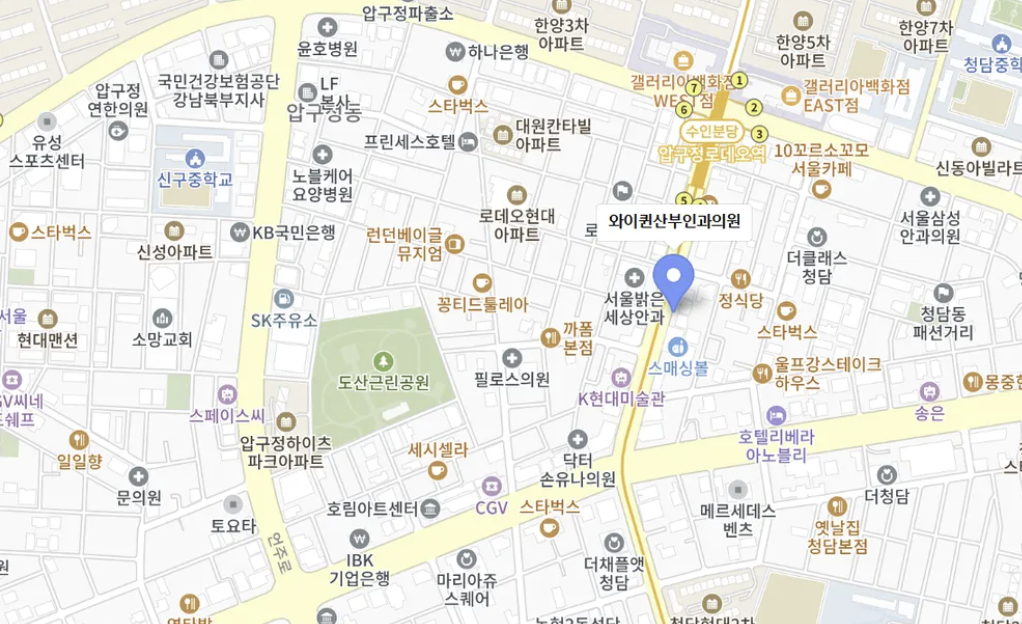
Y Queen Women's Clinic is located in Gangnam, Seoul, with convenient access near Apgujeong Rodeo Station, making it accessible for international patients living or staying in Gangnam, Cheongdam, Sinsa, Itaewon, Myeongdong, and other central Seoul neighborhoods.
Frequently Asked Questions
What is tubal ligation?
Tubal ligation is a permanent method of female contraception in which the fallopian tubes are blocked, interrupted, or removed to prevent pregnancy.
Is tubal ligation permanent?
Yes. Tubal sterilization should be considered permanent. Anyone who may want to become pregnant in the future should discuss reversible contraception alternatives before choosing the procedure.
Can foreigners get a tubal ligation consultation in Seoul?
Yes. Y Queen Women's Clinic welcomes international patients and provides English-speaking contraception and reproductive health consultations.
Does tubal ligation affect my hormones?
Tubal ligation does not remove the ovaries, so it generally does not directly affect normal ovarian hormone production or cause menopause.
Will I still have periods after tubal ligation?
Yes. Most women continue to menstruate after tubal sterilization because the uterus and ovaries remain in place.
Can I become pregnant after tubal ligation?
Pregnancy after tubal sterilization is uncommon but possible. If you have a positive pregnancy test after sterilization, prompt medical evaluation is important to determine the pregnancy location and rule out ectopic pregnancy.
Can tubal ligation be reversed?
Some procedures may potentially be reversed, but reversal is complicated and does not guarantee pregnancy. Tubal sterilization should therefore be chosen only when permanent contraception is desired.
Does Y Queen Women's Clinic perform tubal ligation surgery?
Y Queen Women's Clinic can provide contraception counseling and gynecological evaluation for patients considering permanent sterilization. When hospital-based surgery or specialized surgical care is required, referral to an appropriate medical facility can be arranged.