IUD Placement and Removal in Seoul Gangnam Y Queen Women's Clinic
Y Queen Women's Clinic provides English-speaking IUD placement and removal consultations in Gangnam, Seoul for local and international patients. IUDs are highly effective, long-acting, reversible contraceptive devices available in hormonal and copper forms. Hormonal IUDs may also reduce menstrual bleeding and cramps in selected patients, while copper IUDs provide hormone-free contraception but may increase menstrual bleeding or cramping. IUD placement is usually a brief outpatient gynecological procedure, and removal is generally quick when the strings are accessible. Patients with missing strings, pelvic pain, unusual bleeding, suspected displacement, or pregnancy symptoms may require examination or ultrasound. Fertility can return rapidly after IUD removal. Y Queen Women's Clinic offers confidential, foreigner-friendly contraception counseling, IUD care, menstrual health assessment, and individualized family-planning support in Gangnam, Seoul.
What Is an IUD?
An IUD is a small device that a healthcare professional places inside the uterus.
It provides long-term contraception without requiring a daily pill.
The two main categories are:
- Hormonal IUDs
- Copper IUDs
Both are highly effective forms of reversible contraception, but they work differently and can have different effects on menstrual bleeding.
What Is a Hormonal IUD?
A hormonal IUD releases a small amount of a progestin hormone into the uterus.
Depending on the specific product, hormonal IUDs can provide contraception for several years.
They may also:
- Reduce menstrual bleeding
- Reduce menstrual cramps in some patients
- Make periods lighter
- Cause periods to stop in some users
- Provide long-term reversible contraception
Bleeding patterns can be irregular during the first months after placement.
What Is a Copper IUD?
A copper IUD is a hormone-free contraceptive device.
Copper affects sperm function and helps prevent fertilization.
Potential advantages include:
- No contraceptive hormones
- Long-term pregnancy prevention
- Rapid return to fertility after removal
- No need to remember a daily medication
However, copper IUDs may make periods heavier or more painful, particularly during the first months after insertion.
Hormonal IUD vs. Copper IUD
The best option depends on your health and preferences.
Hormonal IUD
May be preferred by patients who want:
- Long-term contraception
- Lighter periods
- Reduced menstrual bleeding
- Reduced menstrual cramps in some cases
Copper IUD
May be preferred by patients who:
- Want hormone-free contraception
- Cannot or prefer not to use hormonal contraception
- Want long-term reversible birth control
Your doctor can discuss the advantages and disadvantages of each option.
How Effective Is an IUD?
IUDs are among the most effective reversible contraceptive methods available.
They are more than 99% effective at preventing pregnancy when properly placed.
Their effectiveness does not depend on remembering to take a daily pill or use contraception each time you have sex.
Who May Consider an IUD?
An IUD may be appropriate for patients who:
- Want highly effective contraception
- Prefer long-term birth control
- Do not want to take a daily contraceptive pill
- Want reversible contraception
- Want to delay pregnancy for several years
- Prefer a hormone-free option
- Have heavy menstrual bleeding that may benefit from an appropriate hormonal IUD
- Want contraception after childbirth when medically appropriate
IUD suitability should be assessed individually.
Can Women Who Have Never Given Birth Get an IUD?
Yes.
Having never given birth does not automatically prevent someone from using an IUD.
IUDs can be considered for both:
- Patients who have given birth
- Patients who have never given birth
Insertion experience and individual anatomy vary, so your doctor can discuss what to expect.
Who May Not Be Suitable for an IUD?
Depending on the situation, IUD placement may need to be delayed or avoided in patients with:
- Known or suspected pregnancy
- Certain active pelvic infections
- Unexplained abnormal uterine bleeding requiring evaluation
- Certain abnormalities of the uterine cavity
- Some cervical or uterine conditions
- Certain medical contraindications specific to the IUD type
For example, hormonal and copper IUDs have different contraindications.
A medical consultation is therefore important before placement.
What Happens Before IUD Placement?
Before insertion, your appointment may include:
- Medical history review
- Contraception consultation
- Menstrual history
- Pregnancy risk assessment
- Discussion of previous pregnancies
- Review of medications
- Pelvic examination when appropriate
- Pregnancy testing when indicated
- STI testing when indicated
- Discussion of IUD options
- Explanation of risks and side effects
Additional evaluation may be recommended depending on your symptoms and medical history.
Do I Need a Pregnancy Test Before IUD Placement?
Your healthcare provider needs to be reasonably certain that you are not pregnant before placing an IUD.
Depending on your menstrual history and recent sexual activity, this may involve:
- Review of your last menstrual period
- Contraceptive history
- Pregnancy testing
- Additional assessment when necessary
Tell your doctor if there is any possibility you could be pregnant.
Do I Need STD Testing Before an IUD?
STI testing may be recommended depending on your sexual history, symptoms, and risk factors.
Testing may include screening for infections such as:
- Chlamydia
- Gonorrhea
- Other infections when indicated
An active cervical or pelvic infection may need treatment before or around the time of IUD placement depending on the clinical situation.
IUD Placement Procedure
IUD placement is usually performed during an outpatient gynecological appointment.
The procedure generally involves:
- Positioning for a pelvic examination
- Placement of a speculum
- Examination of the cervix
- Cleaning and preparation of the cervix
- Measurement or assessment of the uterine cavity when appropriate
- Passing the IUD through the cervix
- Positioning the IUD inside the uterus
- Trimming the IUD strings
The insertion itself is generally brief, although the complete appointment takes longer.
Does IUD Placement Hurt?
Pain varies significantly between patients.
During insertion, you may experience:
- Cramping
- Pressure
- Brief sharp discomfort
- Menstrual-like pain
Some patients experience mild discomfort, while others experience more significant pain.
Discuss pain-management options with your doctor before the procedure, particularly if you are worried about insertion pain or have previously had painful gynecological procedures.
Pain Management During IUD Placement
Pain-management options depend on individual circumstances and clinic protocol.
Your doctor may discuss options such as:
- Oral pain medication
- Local anesthetic
- Cervical anesthesia in selected cases
- Other approaches based on medical history and expected difficulty
Patients should feel comfortable asking about pain management before insertion.
How Long Does IUD Placement Take?
The actual insertion usually takes only a few minutes.
The overall appointment may take longer because it can include:
- Consultation
- Pregnancy assessment
- Pelvic examination
- Preparation
- IUD insertion
- Short observation period
- Aftercare instructions
Can an IUD Be Inserted During My Period?
An IUD can sometimes be inserted during menstruation, but it does not always need to be placed during a period.
The important issue is that your healthcare provider can reasonably exclude pregnancy and determine that insertion is medically appropriate.
Your doctor can recommend the best timing based on your cycle and contraceptive history.
What Should I Expect After IUD Placement?
After insertion, temporary symptoms can include:
- Cramping
- Light bleeding
- Spotting
- Pelvic discomfort
Bleeding patterns can change during the following weeks or months.
With a hormonal IUD, periods may gradually become:
- Lighter
- Shorter
- Less frequent
- Absent in some patients
With a copper IUD, periods may initially become:
- Heavier
- Longer
- More painful
These patterns vary between individuals.
How Soon Does an IUD Start Working?
This depends on:
- The type of IUD
- When it is inserted in relation to your menstrual cycle
- Your recent contraceptive use
Some IUDs provide contraceptive protection immediately in certain circumstances, while temporary backup contraception may be recommended in others.
Your doctor should tell you whether you need backup contraception after placement.
Can I Exercise After IUD Placement?
Many patients can return to normal daily activity relatively quickly.
If you experience significant cramping or discomfort, you may prefer to temporarily reduce strenuous activity.
Follow your physician's instructions based on how you feel after insertion.
When Can I Have Sex After IUD Placement?
Your doctor can advise when sexual intercourse is appropriate after placement and whether backup contraception is needed.
This depends partly on:
- IUD type
- Timing of insertion
- Symptoms
- Individual circumstances
An IUD does not protect against sexually transmitted infections.
Can My Partner Feel the IUD?
The IUD itself sits inside the uterus and should not normally be felt during intercourse.
The IUD has thin strings extending through the cervix into the upper vagina.
Occasionally, a partner may notice the strings.
If the strings are uncomfortable or seem unusually long, your healthcare provider can check the IUD position.
How Do I Check My IUD Strings?
Some patients are advised to periodically check for their IUD strings.
If you choose to check them:
- Wash your hands
- Gently insert a finger into the vagina
- Feel near the cervix for the thin strings
Do not pull the strings.
If you cannot feel them, this does not automatically mean the IUD has moved, but you should contact your healthcare provider if you are concerned.
IUD Follow-Up
Routine follow-up recommendations can vary.
You should seek medical evaluation if you experience:
- Severe or worsening pelvic pain
- Heavy bleeding
- Fever
- Foul-smelling discharge
- Possible pregnancy
- New severe pain during intercourse
- Inability to feel previously noticeable strings
- Strings that suddenly seem much longer
- Feeling the hard portion of the IUD
An examination or ultrasound may be recommended to confirm position.
IUD Ultrasound Check
Pelvic ultrasound can be useful when there is concern about IUD position.
An ultrasound may be recommended if:
- Strings cannot be located
- Pelvic pain develops
- Bleeding is unusual
- Placement was difficult
- IUD displacement is suspected
- Pregnancy occurs with an IUD
- There is another clinical concern
Ultrasound is not necessarily required after every uncomplicated IUD placement.
IUD Removal in Seoul
IUD removal is usually a brief outpatient procedure.
Patients may request removal because:
- The IUD has reached its recommended replacement time
- They want to become pregnant
- They want to change contraception
- They are experiencing unwanted side effects
- Bleeding patterns are unacceptable
- They have pelvic discomfort
- Their doctor recommends removal
- They no longer need contraception
You do not need to wait until the IUD expires if you want it removed.
What Happens During IUD Removal?
During routine removal:
- A speculum is placed in the vagina.
- The cervix and IUD strings are identified.
- The strings are gently grasped.
- The IUD is slowly withdrawn through the cervix.
- The device is checked after removal.
For many patients, removal is quicker than insertion.
Does IUD Removal Hurt?
Most routine removals cause only brief cramping or discomfort.
Some patients may feel:
- Pressure
- A short cramp
- Mild pelvic discomfort
More complex removal may be necessary if the strings cannot be seen or the device is not in its expected position.
What If My IUD Strings Are Missing?
Missing strings do not necessarily mean the IUD is lost.
Possible explanations include:
- Strings have curled into the cervical canal
- Strings have moved higher into the uterus
- The IUD has changed position
- The IUD has been expelled
- Rarely, uterine perforation may have occurred
Your doctor may use:
- Pelvic examination
- Ultrasound
- Specialized instruments
- Additional imaging when necessary
to determine the IUD location.
Difficult IUD Removal
Occasionally, routine removal is not possible.
This may happen when:
- Strings are not visible
- The IUD is embedded
- The device is malpositioned
- The cervix is difficult to access
- Part of the device has become lodged
Depending on the situation, ultrasound-guided removal or hysteroscopic removal may be considered.
Can an IUD Be Removed at Any Time?
In general, an IUD can be removed whenever contraception is no longer desired or when medical removal is recommended.
However, pregnancy can occur quickly after removal.
If you do not want to become pregnant, discuss alternative contraception before removing the device.
How Quickly Does Fertility Return After IUD Removal?
Fertility can return rapidly after removal of both hormonal and copper IUDs.
There is generally no required waiting period before trying to conceive solely because an IUD has been removed.
Individual fertility depends on other reproductive factors.
Can I Replace My IUD During the Same Appointment?
In many cases, an old IUD can be removed and a new one placed during the same visit.
Suitability depends on:
- Pregnancy risk
- Infection concerns
- Cervical and uterine findings
- Reason for removal
- Availability of the replacement device
Your doctor can determine whether same-day replacement is appropriate.
IUD Removal for Pregnancy Planning
If you are planning pregnancy, an IUD can be removed when you are ready to start trying.
Your preconception consultation may also include discussion of:
- Folic acid
- Vaccination history
- Medications
- Medical conditions
- Menstrual cycle
- Fertility concerns
- Prenatal health
Fertility may return immediately after removal.
IUDs and Menstrual Bleeding
Different IUDs can affect menstruation differently.
Hormonal IUD
May cause irregular spotting initially, followed by lighter or less frequent periods in many patients.
Copper IUD
May cause heavier, longer, or more painful periods, especially during the first several months.
Discuss your usual menstrual pattern before choosing an IUD.
IUD for Heavy Periods
Certain hormonal IUDs may be used to manage heavy menstrual bleeding in appropriate patients.
Before treatment, your doctor may evaluate for other causes of heavy bleeding, such as:
- Fibroids
- Adenomyosis
- Endometrial polyps
- Hormonal disorders
- Pregnancy-related conditions
- Bleeding disorders
An IUD should not automatically be used without investigating unexplained abnormal bleeding.
IUD and Fibroids
Some patients with uterine fibroids can use an IUD.
However, fibroids that significantly distort the uterine cavity may affect:
- Placement
- Position
- Expulsion risk
- Effectiveness
- Bleeding symptoms
Pelvic ultrasound may be recommended before placement in selected patients.
IUD and Adenomyosis
Hormonal IUDs may be considered as part of treatment for some patients with adenomyosis.
Potential benefits may include reduction in:
- Heavy menstrual bleeding
- Menstrual pain
Treatment depends on symptoms, uterine anatomy, fertility plans, and other clinical factors.
IUD and Endometriosis
Hormonal contraception, including certain hormonal IUDs, may be considered for symptom management in selected patients with endometriosis.
An IUD does not surgically remove endometriosis lesions.
Treatment should be individualized according to symptoms and pregnancy plans.
Does an IUD Protect Against STDs?
No.
Neither hormonal nor copper IUDs protect against sexually transmitted infections.
Condoms can help reduce the risk of infections such as:
- Chlamydia
- Gonorrhea
- HIV
- Other sexually transmitted infections
STI screening may be recommended based on individual risk.
Can I Get Pregnant With an IUD?
Pregnancy with a correctly positioned IUD is uncommon because IUDs are highly effective.
However, no contraceptive method is 100% effective.
If you have:
- A positive pregnancy test
- Missed period with pregnancy symptoms
- Significant pelvic pain
- Unusual bleeding
seek medical evaluation promptly.
Pregnancy occurring with an IUD requires professional assessment, including consideration of ectopic pregnancy.
IUD Expulsion
An IUD can occasionally partially or completely come out of the uterus.
Possible signs include:
- Strings suddenly appearing longer
- Feeling the hard part of the IUD
- New cramping
- Unexpected bleeding
- Inability to locate previously noticeable strings
If expulsion is suspected, use backup contraception and arrange medical evaluation.
IUD Perforation
Uterine perforation is a rare complication in which an IUD passes partly or completely through the uterine wall.
Symptoms can vary.
If perforation is suspected, evaluation may include ultrasound or other imaging.
Treatment depends on the location of the device and clinical circumstances.
Risks and Possible Side Effects
Potential risks and side effects of IUD placement include:
- Cramping
- Spotting
- Changes in menstrual bleeding
- Expulsion
- Infection around the time of insertion
- Malposition
- Rare uterine perforation
- Pregnancy despite the IUD
Hormonal IUDs may also cause hormone-related side effects in some users.
Your doctor should discuss risks associated with the specific IUD being considered.
When Should I Seek Medical Attention?
Contact a healthcare professional if you experience:
- Severe pelvic pain
- Fever
- Heavy bleeding
- Foul-smelling vaginal discharge
- Positive pregnancy test
- Severe pain during intercourse
- Suspected IUD expulsion
- Sudden major change in string length
- Feeling the hard IUD itself
- Symptoms that are worsening rather than improving
Severe pain with pregnancy symptoms requires prompt evaluation.
How Should I Prepare for an IUD Appointment?
Before your appointment:
- Know the first day of your last period
- Tell your doctor about recent unprotected sex
- Mention previous pregnancies
- List medications
- Discuss allergies
- Mention previous IUD use
- Tell your doctor about abnormal bleeding
- Mention pelvic infections or STIs
- Discuss your future pregnancy plans
- Ask about pain-management options
If you already have an IUD, bring any information you have about the device, including its brand and insertion date.
IUD Placement and Removal Cost in Seoul
At Y Queen Women's Clinic:
- Consultation fees depend on the evaluation required.
- IUD placement costs vary according to the device selected.
- Hormonal and copper IUDs may have different prices.
- Removal costs depend on whether the removal is routine or complex.
- Additional costs may apply for pregnancy testing, STI testing, pelvic ultrasound, medication, or other examinations.
Current device availability and exact pricing can be confirmed during consultation.
Why Choose Y Queen Women's Clinic?
International patients choose Y Queen because of its:
- English-speaking medical support
- Female-focused gynecological care
- Hormonal and non-hormonal contraception counseling
- IUD placement consultation
- IUD removal services
- Evaluation of missing IUD strings
- Pelvic ultrasound when clinically indicated
- Menstrual health assessment
- Pregnancy planning counseling
- STD testing when appropriate
- Confidential consultation environment
- Personalized contraceptive planning
- Convenient Gangnam location
- Foreigner-friendly appointment process
- Follow-up women's healthcare
Our approach focuses on helping each patient choose contraception according to medical history, menstrual symptoms, lifestyle, and reproductive plans.
Convenient Location in Gangnam
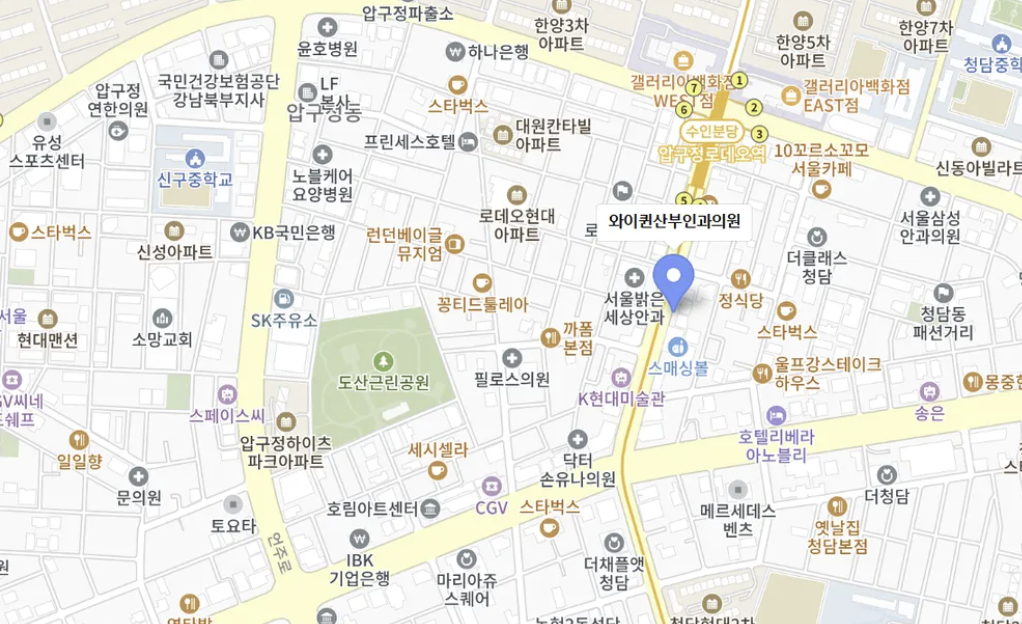
Y Queen Women's Clinic is located in Gangnam, Seoul, with convenient access near Apgujeong Rodeo Station.
The clinic is convenient for international patients living, working, studying, or staying in Gangnam, Cheongdam, Apgujeong, Sinsa, Itaewon, Myeongdong, and other central Seoul neighborhoods.
Frequently Asked Questions
What is an IUD?
An IUD is a small contraceptive device placed inside the uterus to provide highly effective, long-term, reversible pregnancy prevention.
What types of IUDs are available?
The two main categories are hormonal IUDs and copper IUDs. Specific brands and availability vary by country and clinic.
How effective is an IUD?
IUDs are more than 99% effective at preventing pregnancy.
Can foreigners get an IUD in Seoul?
Yes. Y Queen Women's Clinic welcomes international patients and provides English-speaking assistance for contraception, IUD placement, removal, and follow-up consultations.
Can I get an IUD if I have never given birth?
Yes. IUDs can be appropriate for patients who have never given birth as well as those who have.
Does IUD insertion hurt?
Pain varies. Some patients experience mild cramping, while others experience more significant discomfort. Pain-management options can be discussed before insertion.
How long does IUD placement take?
The actual insertion generally takes only a few minutes, although the complete appointment takes longer.
Do I need to be on my period for IUD insertion?
Not necessarily. An IUD can often be inserted at other times when the healthcare provider can reasonably exclude pregnancy.
How long does an IUD last?
Duration depends on the exact hormonal or copper IUD used. Different products are approved for different lengths of use.
Can an IUD make periods lighter?
Hormonal IUDs often reduce menstrual bleeding over time. Some patients eventually have very light or absent periods.
Can a copper IUD make periods heavier?
Yes. Copper IUDs can cause heavier or more painful periods, particularly during the first several months.
Can I remove my IUD whenever I want?
Yes. An IUD can generally be removed when you no longer want it, but alternative contraception should be discussed if pregnancy is not desired.
How quickly can I get pregnant after IUD removal?
Fertility can return rapidly after IUD removal.
What happens if my IUD strings are missing?
Your doctor may perform a pelvic examination and ultrasound to determine the location of the IUD. Missing strings do not necessarily mean the IUD has been expelled.
Can my IUD be removed and replaced on the same day?
Often yes, provided there is no medical reason to delay replacement.
Does an IUD protect against STDs?
No. IUDs prevent pregnancy but do not protect against sexually transmitted infections.
Can I get pregnant while using an IUD?
Pregnancy is uncommon but possible. A positive pregnancy test while an IUD is in place requires prompt medical assessment.
Does Y Queen Women's Clinic provide IUD placement and removal?
Y Queen Women's Clinic provides consultation for contraception and can evaluate patients seeking IUD placement, removal, replacement, or assessment of IUD-related symptoms. Current IUD brands, device availability, suitability, and pricing should be confirmed during an individual consultation.