Emergency Contraception
in Seoul
at Gangnam Y Queen Women's Clinic
Y Queen Women's Clinic provides English-speaking emergency contraception consultations in Gangnam, Seoul for local and international patients. Emergency contraception is used after unprotected intercourse, condom failure, missed birth control, or other contraceptive problems to reduce the chance of pregnancy. Available options may include emergency contraceptive pills and, for selected patients, a copper IUD. Treatment works best when sought promptly, and the appropriate option depends on time since intercourse, menstrual-cycle timing, medications, current contraception, and individual medical factors. Emergency contraception is not the same as abortion medication and does not protect against sexually transmitted infections or additional unprotected sex later in the cycle. Y Queen Women's Clinic also provides pregnancy-risk assessment, follow-up testing, STI counseling, and ongoing contraception planning in a confidential, foreigner-friendly environment.
What Is Emergency Contraception?
Emergency contraception refers to methods used after unprotected intercourse to reduce the chance of pregnancy.
Depending on medical suitability and availability, options may include:
- Emergency contraceptive pills
- Copper IUD placement in selected patients
- Follow-up pregnancy testing
- Ongoing contraception planning
Emergency contraception is intended for occasional urgent situations rather than as a primary routine contraceptive method.
When Should I Consider Emergency Contraception?
You may want to seek emergency contraception if:
- You had unprotected vaginal intercourse
- A condom broke
- A condom slipped off
- You missed birth control pills
- You started your pill pack late
- Your contraceptive patch or ring was used incorrectly
- You missed a contraceptive injection
- You are unsure whether your contraception was effective
- Withdrawal failed
- You had sex without contraception and do not want pregnancy
The best option depends partly on how much time has passed.
How Soon Should I Take Emergency Contraception?
Emergency contraception is generally more effective when used as soon as possible after unprotected intercourse.
Different emergency contraceptive options have different time windows.
Because timing matters, it is better to seek medical advice promptly rather than wait until the end of the available treatment window.
Your doctor can recommend an option based on:
- Time since intercourse
- Menstrual cycle timing
- Current contraception
- Medications
- Weight and other individual factors
- Pregnancy risk
What Types of Emergency Contraception Are Available?
Emergency contraception may include oral medication or an IUD.
Emergency Contraceptive Pills
Emergency pills work mainly by delaying or preventing ovulation.
The exact medication available depends on local regulations and current product availability.
Copper IUD
A copper IUD can also be used as emergency contraception in appropriately selected patients and provides ongoing long-term contraception after placement.
The best method depends on your timing, medical history, and future contraception preferences.
How Do Emergency Contraceptive Pills Work?
Emergency contraceptive pills primarily work by delaying or preventing ovulation.
If ovulation has not yet occurred, delaying egg release can reduce the chance that sperm and egg will meet.
Emergency contraception does not reliably terminate an established pregnancy.
It is therefore different from abortion medication.
Is Emergency Contraception the Same as the Abortion Pill?
No.
Emergency contraception and medication abortion are different.
Emergency Contraception
Is used after unprotected sex to reduce the chance that pregnancy begins.
Medication Abortion
Is used after pregnancy has already been established and confirmed.
Emergency contraceptive pills do not function as abortion pills.
Does Emergency Contraception Affect an Existing Pregnancy?
Emergency contraception is not intended to terminate an established pregnancy.
If you already have a positive pregnancy test or suspect an existing pregnancy from earlier intercourse, you need a different type of medical evaluation.
Your doctor can advise whether pregnancy testing or ultrasound is appropriate.
What Happens During Your Consultation?
Your appointment may include:
- Confidential medical consultation
- Date and time of unprotected intercourse
- Menstrual history
- First day of your last period
- Review of current contraception
- Review of missed contraceptive doses
- Medication review
- Pregnancy risk assessment
- Discussion of emergency contraception options
- Pregnancy testing when appropriate
- STI testing when indicated
- Ongoing contraception counseling
The goal is to select the most appropriate option based on timing and your individual circumstances.
Do I Need a Pregnancy Test First?
Not always.
Emergency contraception is often needed before a pregnancy test would become positive from the recent intercourse in question.
However, pregnancy testing may be recommended if:
- Your period is already late
- You had unprotected sex earlier in the cycle
- You have pregnancy symptoms
- There is uncertainty about an existing pregnancy
- Your doctor has another clinical reason to test
A negative test immediately after recent unprotected intercourse cannot rule out pregnancy from that encounter.
Can I Take Emergency Contraception During Ovulation?
Effectiveness can depend on whether ovulation has already occurred.
Because oral emergency contraception primarily works by delaying ovulation, it may be less effective if ovulation has already happened.
This is one reason timing and cycle history matter.
Your doctor can discuss whether an alternative option such as a copper IUD may be appropriate.
Copper IUD as Emergency Contraception
A copper IUD may be considered as emergency contraception in selected patients.
Potential advantages include:
- Very high contraceptive effectiveness
- Continued long-term contraception after placement
- No contraceptive hormones
However, an IUD is not appropriate for everyone.
Your doctor will review:
- Pregnancy risk
- Pelvic infection risk
- Uterine anatomy
- Menstrual history
- Medical contraindications
- Future contraception preferences
Emergency Contraception After a Condom Break
Emergency contraception may be appropriate if a condom:
- Broke
- Tore
- Slipped off
- Was used incorrectly
- Was applied after intercourse had already begun
The appropriate response depends on:
- Whether ejaculation occurred
- Timing in your menstrual cycle
- How much time has passed
- Whether another contraceptive method is also being used
STI testing may also be worth considering depending on the situation.
Emergency Contraception After Missed Birth Control Pills
Whether you need emergency contraception depends on:
- Type of pill
- Number of pills missed
- When they were missed
- Whether unprotected intercourse occurred
- Where you are in the pill pack
Different pill formulations have different missed-pill instructions.
Bring the name or packaging of your contraceptive pill if possible.
Emergency Contraception After Missed Patch or Ring
Pregnancy risk may increase if a contraceptive patch or vaginal ring was:
- Started late
- Left off too long
- Removed too early
- Used outside the recommended schedule
Whether emergency contraception is needed depends on the specific product and timing.
Your doctor can review the details and advise what to do next.
Emergency Contraception After a Missed Injection
If a scheduled contraceptive injection is significantly delayed, contraceptive protection may decrease.
Your doctor can assess:
- How late the injection is
- When intercourse occurred
- Whether emergency contraception is needed
- When the next injection should be given
- Whether backup contraception is required
Does Body Weight Affect Emergency Contraception?
Body weight and BMI may influence the effectiveness of some oral emergency contraceptive options.
The degree of effect varies by medication.
If weight is a concern, your doctor can discuss whether a different emergency contraceptive method may be more reliable.
Medication Interactions
Certain medications can reduce the effectiveness of some emergency contraceptive pills.
Important examples may include selected:
- Seizure medications
- Tuberculosis medications
- HIV medications
- Liver enzyme-inducing drugs
- Herbal products such as St. John's wort
Tell your doctor about all medications and supplements you are taking.
What Side Effects Can Emergency Contraception Cause?
Possible temporary side effects may include:
- Nausea
- Headache
- Fatigue
- Dizziness
- Breast tenderness
- Abdominal discomfort
- Spotting
- Changes in the timing of your next period
Most side effects are temporary.
Contact your healthcare provider if symptoms are severe or concerning.
Will Emergency Contraception Make My Period Late?
Yes, your next period may come:
- Earlier than expected
- Later than expected
- Heavier
- Lighter
A small shift in cycle timing can occur after emergency contraception.
If your period is significantly delayed, pregnancy testing may be recommended.
When Should I Take a Pregnancy Test?
Your doctor may recommend a pregnancy test if:
- Your next period is significantly late
- You develop pregnancy symptoms
- You have unusual bleeding
- You remain concerned about pregnancy
- You had additional unprotected intercourse after treatment
A follow-up pregnancy test is often more informative than testing immediately after the recent intercourse.
What If I Vomit After Taking Emergency Contraception?
Vomiting soon after taking an emergency contraceptive pill may affect absorption.
If you vomit shortly after taking the medication, contact your healthcare provider or pharmacist promptly.
You may need another dose depending on the timing and medication used.
Can I Take Emergency Contraception More Than Once?
Emergency contraception can be used again if another episode of unprotected intercourse occurs, depending on the medication and circumstances.
However, repeated need for emergency contraception may indicate that a more reliable ongoing contraceptive method would be helpful.
Options may include:
- Birth control pills
- IUD
- Nexplanon
- Patch
- Vaginal ring
- Injectable contraception
- Condoms
Does Emergency Contraception Affect Future Fertility?
Emergency contraceptive pills do not permanently reduce fertility.
They are intended to provide short-term pregnancy prevention after a specific episode of contraceptive failure or unprotected sex.
Future fertility returns normally afterward.
Can Emergency Contraception Cause Infertility?
No evidence supports the idea that emergency contraceptive pills cause infertility when used appropriately.
If you are having difficulty becoming pregnant later, other fertility factors should be evaluated separately.
Can I Start Regular Birth Control After Emergency Contraception?
Often yes, but the timing depends on which emergency contraceptive medication was used.
Some methods can be started or resumed immediately, while others may require a short delay and temporary use of condoms.
Your doctor should give you specific instructions based on:
- Emergency contraception type
- Regular contraceptive method
- Timing in your cycle
Do I Need Backup Contraception?
You may need condoms or abstinence for a period after emergency contraception, depending on:
- The emergency contraceptive used
- Whether you restart or begin hormonal contraception
- Timing of treatment
- Your contraceptive method
Follow your physician's specific instructions.
Does Emergency Contraception Protect Me for the Rest of the Cycle?
No.
Emergency contraception does not automatically protect you from pregnancy after additional unprotected intercourse later in the same cycle.
You may still become pregnant from sex occurring after the emergency contraceptive was taken.
Use appropriate ongoing contraception.
Does Emergency Contraception Protect Against STDs?
No.
Emergency contraception reduces pregnancy risk but does not protect against sexually transmitted infections.
Depending on the situation, consider:
- Condom use
- Chlamydia testing
- Gonorrhea testing
- HIV testing
- Syphilis testing
- Other STI screening when appropriate
Emergency Contraception After Sexual Assault
Emergency contraception may be one part of medical care after sexual assault.
Other important considerations can include:
- STI prevention and testing
- HIV post-exposure prophylaxis when appropriate
- Injury assessment
- Forensic options
- Psychological support
- Follow-up care
Emergency care may be more appropriate than a routine clinic visit depending on the circumstances and timing.
When Should I Seek Urgent Medical Attention?
Seek prompt medical evaluation if you experience:
- Severe pelvic or abdominal pain
- Fainting
- Heavy bleeding
- Severe dizziness
- Positive pregnancy test with pelvic pain
- Significant one-sided pelvic pain
These symptoms can be associated with conditions such as ectopic pregnancy and require urgent assessment.
Emergency Contraception and Ectopic Pregnancy
Emergency contraception does not cause ectopic pregnancy.
However, if pregnancy occurs despite emergency contraception and you develop severe pelvic pain, bleeding, dizziness, or fainting, medical evaluation is important to determine the pregnancy location.
Can Foreigners Get Emergency Contraception in Seoul?
Yes.
International patients can seek medical consultation in Seoul after unprotected intercourse or contraceptive failure.
At Y Queen Women's Clinic, English-speaking support can help patients explain:
- When intercourse occurred
- What contraception was used
- Which medications they take
- When their last period began
- Whether emergency contraception has already been taken
This can make the consultation easier for patients unfamiliar with the Korean healthcare system.
How Should I Prepare for an Appointment?
If possible, know or bring:
- Date and approximate time of unprotected intercourse
- First day of your last menstrual period
- Usual cycle length
- Name of your regular birth control
- Details of missed pills or contraceptive failure
- Current medications and supplements
- Recent pregnancy test results
- Information about additional unprotected intercourse
- Any STI concerns
Do not delay seeking care just because you do not have all this information.
Emergency Contraception Cost in Seoul
At Y Queen Women's Clinic:
- Consultation fees depend on the evaluation required.
- Medication costs vary depending on the emergency contraceptive prescribed.
- Additional costs may apply for pregnancy testing, STI testing, pelvic ultrasound, or IUD placement when indicated.
- Current medication and device availability can vary.
Exact pricing can be discussed during consultation.
Why Choose Y Queen Women's Clinic?
International patients choose Y Queen because of its:
- English-speaking medical support
- Confidential reproductive healthcare
- Emergency contraception consultation
- Pregnancy risk assessment
- Birth control counseling
- IUD consultation
- Nexplanon and long-term contraception counseling
- Pregnancy testing when appropriate
- STD testing when indicated
- Post-emergency contraception follow-up
- Personalized family-planning support
- Comfortable, private consultation environment
- Convenient Gangnam location
- Foreigner-friendly appointment process
Our approach focuses on timely, confidential care and helping patients choose both immediate and ongoing pregnancy-prevention options.
Convenient Location in Gangnam
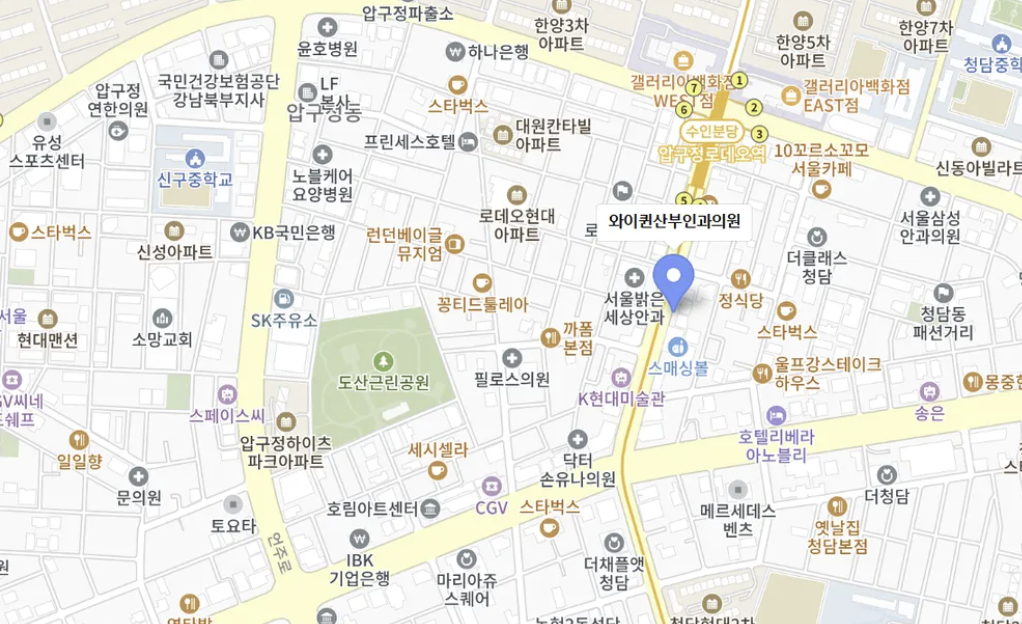
Y Queen Women's Clinic is located in Gangnam, Seoul, with convenient access near Apgujeong Rodeo Station.
The clinic is convenient for international patients living, working, studying, or staying in Gangnam, Cheongdam, Apgujeong, Sinsa, Itaewon, Myeongdong, and other central Seoul neighborhoods.
Frequently Asked Questions
What is emergency contraception?
Emergency contraception is used after unprotected intercourse or contraceptive failure to reduce the chance of pregnancy.
When should I take emergency contraception?
As soon as possible. Different emergency contraceptive methods have different effective time windows, so timely consultation is important.
Can foreigners get emergency contraception in Seoul?
Yes. Y Queen Women's Clinic welcomes international patients and provides English-speaking assistance for emergency contraception, pregnancy risk assessment, and ongoing birth control counseling.
Is emergency contraception the abortion pill?
No. Emergency contraception is used to prevent pregnancy from beginning and does not function as medication abortion.
Does emergency contraception work after ovulation?
Oral emergency contraception mainly works by delaying ovulation, so effectiveness may be lower after ovulation has occurred. Your doctor can discuss alternative options depending on timing.
Can a copper IUD be used as emergency contraception?
Yes, a copper IUD can be considered as emergency contraception for appropriately selected patients and also provides ongoing contraception.
Do I need emergency contraception after a condom breaks?
Possibly. It depends on when the condom broke, whether ejaculation occurred, menstrual-cycle timing, and whether another contraceptive method was being used.
Do I need emergency contraception after missing birth control pills?
Sometimes. The answer depends on the pill type, number and timing of missed pills, and whether unprotected intercourse occurred.
Can emergency contraception make my period late?
Yes. Your next period may come earlier or later than usual and may temporarily differ in flow.
When should I take a pregnancy test afterward?
Pregnancy testing may be recommended if your period is significantly late, you develop pregnancy symptoms, or you remain concerned about pregnancy.
Can I get pregnant later in the same cycle?
Yes. Emergency contraception does not protect against subsequent unprotected intercourse later in the cycle.
Can I use emergency contraception more than once?
It may be used again when necessary, depending on the medication and situation, but frequent use may be a reason to discuss a more reliable ongoing contraceptive method.
Does emergency contraception affect fertility?
No. Emergency contraceptive pills do not permanently reduce future fertility.
Does emergency contraception protect against STDs?
No. Condoms and appropriate STI testing are important when infection risk is a concern.
Can medications make emergency contraception less effective?
Yes. Certain enzyme-inducing medications and supplements can reduce the effectiveness of some emergency contraceptive pills. Tell your doctor about everything you take.
Does Y Queen Women's Clinic provide emergency contraception?
Y Queen Women's Clinic can provide confidential consultation after unprotected intercourse, condom failure, missed contraception, or other pregnancy-risk situations. The clinic can assess timing and medical suitability, discuss available emergency contraceptive options, provide pregnancy or STI testing when appropriate, and help patients choose ongoing contraception.