Morning-After Pills in Seoul
Gangnam Y Queen Women's Clinic
Y Queen Women's Clinic provides English-speaking morning-after pill consultations in Gangnam, Seoul for local and international patients. Morning-after pills are emergency contraceptive medications used after unprotected intercourse, condom failure, missed birth control, or other contraceptive problems to reduce the chance of pregnancy. Depending on the medication, oral emergency contraception may be used within several days after intercourse, but seeking treatment as soon as possible is generally preferable. Morning-after pills primarily work by delaying or preventing ovulation and are not the same as abortion medication. They do not protect against sexually transmitted infections or additional unprotected intercourse later in the menstrual cycle. Y Queen Women's Clinic offers confidential pregnancy-risk assessment, emergency contraception consultation, follow-up pregnancy testing when appropriate, STI counseling, and ongoing birth control planning for international patients in Seoul.
Morning-After Pills in Seoul at Gangnam Y Queen Women's Clinic
The morning-after pill is a form of emergency contraception used to reduce the chance of pregnancy after unprotected vaginal intercourse or contraceptive failure. Despite its name, it does not need to be taken only the morning after sex. Emergency contraceptive pills have specific time windows for use, and they generally work better when taken as soon as possible.
You may consider a morning-after pill after a condom breaks or slips, birth control pills are missed, contraception is used incorrectly, or no contraception was used. At Y Queen Women's Clinic in Gangnam, Seoul, we provide confidential consultations for Korean residents, expats, international students, travelers, and other international patients who need emergency contraception in Korea. Our English-speaking women's health team can assess when intercourse occurred, review your menstrual cycle and medications, discuss appropriate emergency contraception, advise about pregnancy testing, and help you choose ongoing contraception if desired. Because emergency contraception is time-sensitive, patients concerned about pregnancy after recent unprotected sex should seek medical advice promptly.
What Is the Morning-After Pill?
The morning-after pill is an oral emergency contraceptive taken after unprotected intercourse to reduce the likelihood of pregnancy.
It is intended for situations such as:
- Unprotected vaginal intercourse
- Condom breakage
- Condom slippage
- Missed birth control pills
- Incorrect contraceptive use
- Delayed contraceptive injection
- Problems with a contraceptive patch or ring
- Other contraceptive failure
It is not intended to replace a regular contraceptive method.
Is the Morning-After Pill Emergency Contraception?
Yes.
"Morning-after pill" is the commonly used term for an emergency contraceptive pill.
Emergency contraception is a broader category because it can include:
- Emergency contraceptive pills
- Copper IUD placement in appropriate patients
The appropriate option depends on timing, pregnancy risk, medical history, and individual circumstances.
How Does the Morning-After Pill Work?
Emergency contraceptive pills primarily work by preventing or delaying ovulation.
Ovulation is the release of an egg from the ovary.
If ovulation can be delayed until sperm are no longer capable of fertilization, pregnancy may be prevented.
The exact mechanism depends on the emergency contraceptive medication used.
Does the Morning-After Pill Cause an Abortion?
No.
The morning-after pill is not an abortion pill.
Morning-After Pill
Is used to reduce the chance that pregnancy begins after unprotected intercourse.
Abortion Medication
Is used to end an established pregnancy.
Emergency contraceptive pills do not terminate an established pregnancy.
When Should I Take the Morning-After Pill?
Take emergency contraception as soon as possible after unprotected intercourse.
Different medications have different recommended time windows.
Depending on the product, emergency contraceptive pills may be used within approximately:
- 72 hours after intercourse for certain formulations
- Up to 120 hours, or 5 days, for certain other formulations
Earlier treatment is generally preferable.
Do not delay seeking care simply because you are uncertain which medication you need.
Is It Too Late to Take a Morning-After Pill?
Not necessarily.
Even if more than one day has passed, emergency contraception may still be an option.
What is appropriate depends on:
- How many hours or days have passed
- Type of emergency contraceptive available
- Menstrual-cycle timing
- Whether ovulation may have occurred
- Current medications
- Other individual factors
A copper IUD may also be an emergency contraception option for selected patients.
Can I Take the Morning-After Pill After 24 Hours?
Yes.
Emergency contraceptive pills are not limited to the first 24 hours.
However, because effectiveness can depend on timing, seeking treatment sooner is generally better.
Can I Take the Morning-After Pill After 48 Hours?
Emergency contraception may still be available after 48 hours.
The appropriate medication depends on the time since intercourse and individual circumstances.
Contact a healthcare provider promptly rather than waiting longer.
Can I Take the Morning-After Pill After 72 Hours?
Certain emergency contraceptive options may still be considered after 72 hours.
Some oral emergency contraceptive medications have a treatment window extending up to 120 hours after unprotected intercourse.
A copper IUD may also be considered for emergency contraception in selected circumstances.
Medical consultation can help determine the appropriate option.
Morning-After Pill Within 5 Days
Certain emergency contraceptive options may be effective when used within 5 days of unprotected intercourse.
However, waiting until day five is not recommended when treatment can be obtained earlier.
Timing relative to ovulation can also affect effectiveness.
What Types of Morning-After Pills Are Available?
The two major oral emergency contraception approaches internationally use:
- Levonorgestrel
- Ulipristal acetate
They differ in:
- Recommended timing
- Effectiveness at different points after intercourse
- Interaction with ongoing hormonal contraception
- Medication interactions
- Availability
The specific medication available in Korea should be confirmed during consultation.
Levonorgestrel Emergency Contraception
Levonorgestrel is a progestin used in some emergency contraceptive pills.
It works mainly by delaying or preventing ovulation.
Its effectiveness is generally better when taken earlier after unprotected intercourse.
Your doctor can determine whether levonorgestrel is an appropriate option based on timing and your individual circumstances.
Ulipristal Acetate Emergency Contraception
Ulipristal acetate is another medication used for emergency contraception.
It can be used within a defined period after unprotected intercourse and may have advantages in certain circumstances.
Because ulipristal can interact with ongoing progestin-containing contraception, patients need clear instructions about when to start or restart regular hormonal birth control afterward.
Morning-After Pill vs. Copper IUD
Both can be used for emergency contraception in appropriate circumstances.
Morning-After Pill
- Taken orally
- Does not require a uterine procedure
- Designed for emergency pregnancy prevention
- Does not provide ongoing contraception for the rest of the cycle
Copper IUD
- Placed inside the uterus
- Provides highly effective emergency contraception in appropriate patients
- Continues providing long-term contraception afterward
- Requires a gynecological procedure
Your OB-GYN can help determine which option is appropriate.
What Happens During Your Consultation?
Your appointment may include:
- Confidential consultation
- Date and approximate time of intercourse
- First day of your last menstrual period
- Usual cycle length
- Review of contraceptive failure
- Current birth control method
- Medication and supplement review
- Pregnancy risk assessment
- Pregnancy testing when appropriate
- Discussion of available emergency contraception
- STI assessment when indicated
- Ongoing contraception counseling
Providing accurate timing helps your doctor recommend the most appropriate option.
Do I Need a Pregnancy Test Before Taking the Morning-After Pill?
Not necessarily.
A pregnancy test performed immediately after recent intercourse will generally be too early to detect a pregnancy resulting from that encounter.
Testing may still be appropriate if:
- Your period was already late
- You had earlier unprotected intercourse
- You have pregnancy symptoms
- An existing pregnancy is possible
Your doctor can determine whether testing is useful.
Can I Take a Morning-After Pill During Ovulation?
Oral emergency contraception primarily works by delaying or preventing ovulation.
If ovulation has already occurred, oral emergency contraception may be less effective.
Because it can be difficult to know the exact day of ovulation based only on calendar calculations, medical advice can be useful.
A copper IUD may be discussed as another emergency contraception option in selected patients.
Morning-After Pill After Condom Failure
A morning-after pill may be considered if:
- The condom broke
- The condom tore
- The condom slipped off
- The condom was applied incorrectly
- Semen leaked
- Intercourse began before the condom was used
Pregnancy risk depends on cycle timing and the details of the contraceptive failure.
Morning-After Pill After Missed Birth Control Pills
Whether emergency contraception is needed depends on:
- Type of birth control pill
- Number of pills missed
- Where you are in the pill pack
- Timing of intercourse
- When you restarted the pill
If possible, bring the pill package or exact product name to your consultation.
Morning-After Pill After a Missed Contraceptive Injection
If your contraceptive injection is overdue, pregnancy protection may decrease.
Your physician can determine:
- Whether emergency contraception is indicated
- Whether pregnancy testing is necessary
- When the next injection can be administered
- How long backup contraception should be used
Does Weight Affect the Morning-After Pill?
Body weight and BMI may influence the effectiveness of some oral emergency contraceptive medications.
The effect is not identical for every medication.
Patients concerned about body weight and emergency contraception can discuss whether another oral medication or a copper IUD may be preferable.
Medications That Can Affect the Morning-After Pill
Some medications and herbal products can reduce the effectiveness of certain emergency contraceptive pills.
These may include selected:
- Anti-seizure medications
- Tuberculosis medications
- HIV medications
- Other enzyme-inducing medications
- St. John's wort
Tell your doctor about all medications, supplements, and herbal products you take.
What Are the Side Effects?
Possible temporary side effects include:
- Nausea
- Headache
- Fatigue
- Dizziness
- Breast tenderness
- Abdominal discomfort
- Spotting
- Changes in menstrual timing
Side effects are generally temporary.
What If I Vomit After Taking the Morning-After Pill?
Vomiting soon after taking emergency contraception may prevent the medication from being adequately absorbed.
If you vomit shortly after taking the pill, contact your healthcare provider promptly.
Whether another dose is needed depends on the medication and timing.
Will the Morning-After Pill Delay My Period?
It can.
Your next period may:
- Arrive earlier
- Arrive later
- Be lighter
- Be heavier
- Include unexpected spotting
A temporary change in your cycle does not necessarily mean you are pregnant.
However, a significantly delayed period should be followed by pregnancy testing.
Can the Morning-After Pill Make My Period Come Early?
Yes.
Emergency contraception can temporarily change menstrual timing, and some patients experience an earlier-than-expected period or spotting.
When Should I Take a Pregnancy Test?
Pregnancy testing may be appropriate if:
- Your next period is significantly delayed
- You develop pregnancy symptoms
- You have unusual bleeding
- You remain concerned about pregnancy
If there is no withdrawal bleed or menstrual period within about 3 weeks after emergency contraception, pregnancy testing is generally appropriate.
Can I Have Sex After Taking the Morning-After Pill?
Yes, but the emergency contraceptive pill does not necessarily protect you from pregnancy caused by subsequent unprotected intercourse.
Use an appropriate contraceptive method afterward.
Depending on the emergency contraceptive taken, you may need:
- Condoms
- Temporary abstinence
- Specific timing for restarting hormonal contraception
Follow your doctor's instructions.
Does the Morning-After Pill Protect Me for the Rest of My Cycle?
No.
Taking an emergency contraceptive pill after one episode of unprotected sex does not provide reliable contraception for additional intercourse later in the cycle.
Ongoing contraception is important if you want to continue preventing pregnancy.
Can I Start Birth Control After Taking the Morning-After Pill?
Usually, but timing depends on the emergency contraceptive used.
After some emergency contraceptive pills, hormonal contraception can be started or resumed promptly.
After others, starting progestin-containing contraception too soon may reduce the emergency contraceptive's effectiveness.
Your doctor should provide medication-specific instructions.
Can I Take the Morning-After Pill More Than Once?
Emergency contraception may be needed again after another episode of unprotected intercourse.
However, if emergency contraception is needed frequently, consider discussing a regular method such as:
- Birth control pills
- Hormonal IUD
- Copper IUD
- Nexplanon
- Contraceptive injection
- Patch
- Vaginal ring
- Condoms
Regular contraception is generally more reliable for ongoing pregnancy prevention.
Does the Morning-After Pill Affect Future Fertility?
Emergency contraceptive pills do not permanently reduce future fertility.
They temporarily affect the reproductive process around the current menstrual cycle.
They do not cause long-term infertility.
Can the Morning-After Pill Cause Infertility?
No evidence shows that appropriately used emergency contraceptive pills cause infertility.
If future fertility problems occur, they require evaluation for other causes.
Does the Morning-After Pill Protect Against STDs?
No.
Emergency contraception prevents pregnancy; it does not prevent sexually transmitted infections.
Depending on the situation, testing may be considered for:
- Chlamydia
- Gonorrhea
- HIV
- Syphilis
- Other STIs
Condoms can help reduce STI transmission risk.
Morning-After Pill After Sexual Assault
Emergency contraception may be one part of medical care following sexual assault.
Depending on timing and circumstances, additional care may include:
- Injury assessment
- STI testing or preventive treatment
- HIV post-exposure prophylaxis when indicated
- Pregnancy prevention
- Forensic examination options
- Psychological support
Urgent or emergency medical services may be more appropriate than a routine clinic appointment in some circumstances.
When Should I Seek Urgent Medical Care?
Seek prompt medical attention if you experience:
- Severe abdominal or pelvic pain
- Fainting
- Severe dizziness
- Very heavy bleeding
- Positive pregnancy test with pelvic pain
- Significant one-sided pelvic pain
These symptoms require evaluation for pregnancy-related or other gynecological conditions.
Can Foreigners Get Morning-After Pills in Seoul?
Yes.
International patients can seek emergency contraception through appropriate medical care in Korea.
Y Queen Women's Clinic provides English-speaking consultation for patients concerned about pregnancy after unprotected intercourse or contraceptive failure.
Because medication access and prescribing requirements can differ between countries, international visitors should seek local medical advice rather than relying on instructions from medication purchased elsewhere.
How Should I Prepare for My Appointment?
If possible, know:
- Date and approximate time of unprotected intercourse
- First day of your last period
- Typical menstrual-cycle length
- Current birth control method
- Details of missed pills or contraceptive failure
- Current medications
- Supplements and herbal products
- Whether you had other unprotected intercourse earlier in the cycle
- Whether your period was already late
Do not delay treatment if you cannot provide every detail.
Morning-After Pill Cost in Seoul
At Y Queen Women's Clinic:
- Consultation fees depend on the evaluation required.
- Medication costs vary according to the emergency contraceptive prescribed.
- Additional costs may apply for pregnancy testing, STI testing, pelvic ultrasound, or other examinations when clinically indicated.
- Medication availability and pricing can change.
Current options and exact costs can be confirmed during consultation.
Why Choose Y Queen Women's Clinic?
International patients choose Y Queen because of its:
- English-speaking medical support
- Confidential emergency contraception consultations
- Morning-after pill consultation
- Pregnancy risk assessment
- Pregnancy testing when appropriate
- Birth control counseling
- IUD and Nexplanon counseling
- STD testing when indicated
- Ongoing contraception planning
- Personalized women's healthcare
- Comfortable, private consultation environment
- Convenient Gangnam location
- Foreigner-friendly appointment process
- Follow-up gynecological care
Our approach focuses on timely, confidential assessment and helping patients understand both immediate emergency contraception and longer-term pregnancy prevention options.
Convenient Location in Gangnam
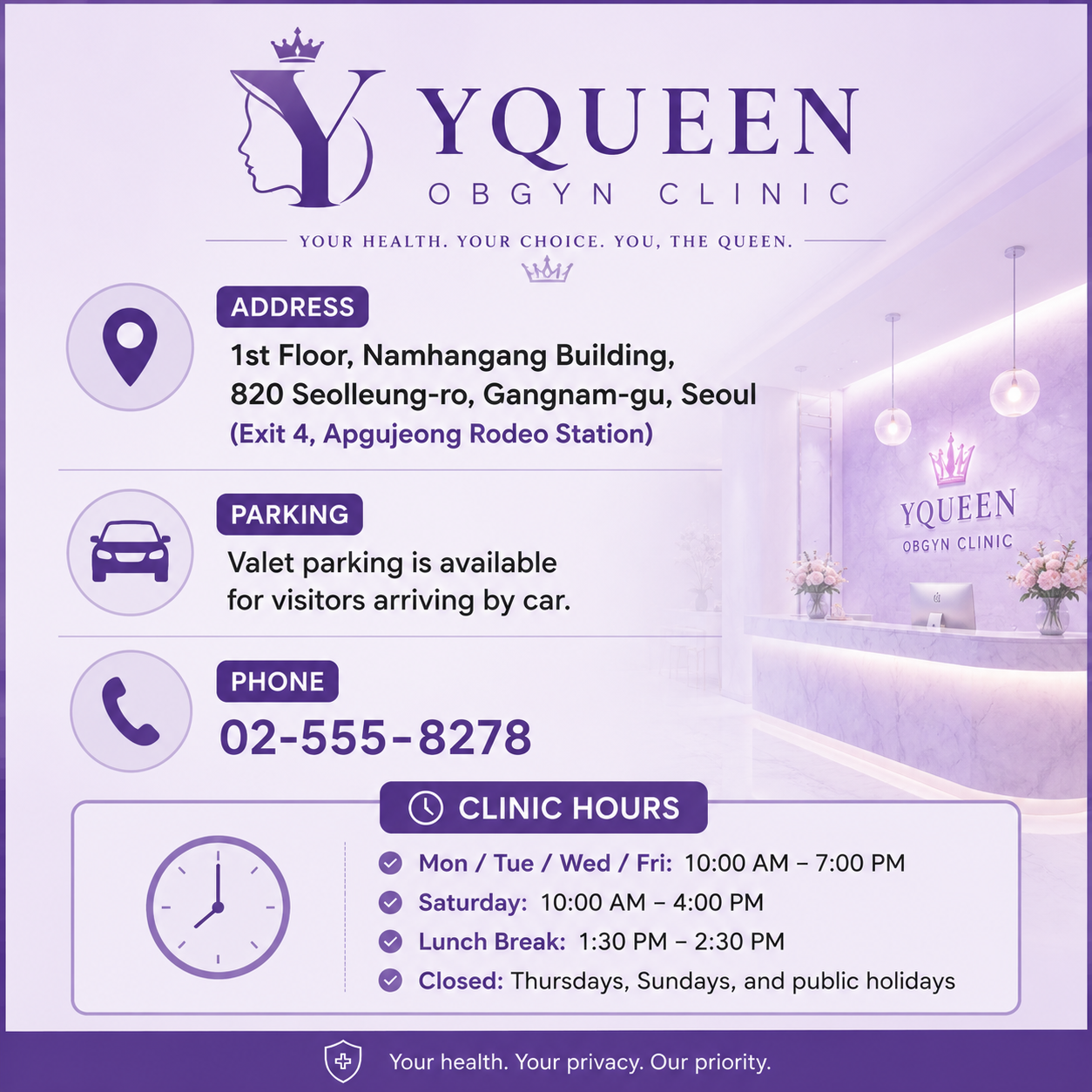
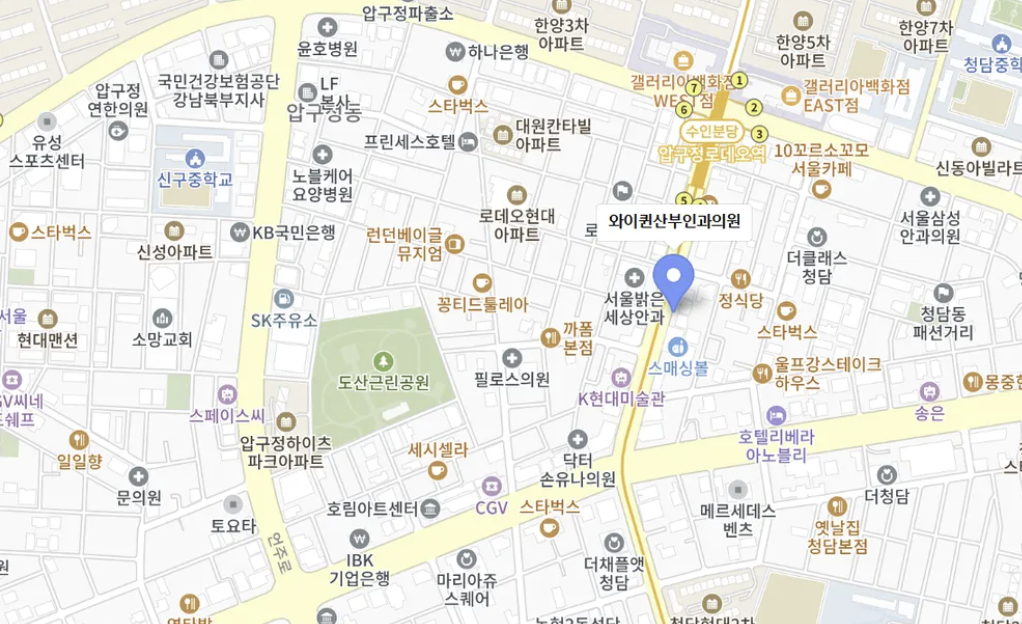
Y Queen Women's Clinic is located in Gangnam, Seoul, with convenient access near Apgujeong Rodeo Station.
The clinic is convenient for international patients living, working, studying, or staying in Gangnam, Cheongdam, Apgujeong, Sinsa, Itaewon, Myeongdong, and other central Seoul neighborhoods.
Frequently Asked Questions
What is the morning-after pill?
The morning-after pill is emergency contraception taken after unprotected intercourse or contraceptive failure to reduce the chance of pregnancy.
Can foreigners get the morning-after pill in Seoul?
Yes. Y Queen Women's Clinic provides English-speaking consultation for international patients seeking emergency contraception in Seoul.
Do I need a prescription for the morning-after pill in Korea?
Emergency contraceptive medication access in South Korea is subject to local prescribing rules. Y Queen Women's Clinic can provide medical consultation and determine an appropriate emergency contraception option.
How soon should I take the morning-after pill?
As soon as possible. Different emergency contraceptive pills have different time windows, and earlier treatment is generally preferable.
Can I take a morning-after pill after 24 hours?
Yes. Oral emergency contraception may still be an option after 24 hours.
Can I take it after 48 hours?
Yes. Emergency contraception may still be available, but you should seek medical advice promptly.
Can I take it after 72 hours?
Certain emergency contraception options may still be available after 72 hours, including some options used for up to 120 hours after intercourse.
Is the morning-after pill effective for 5 days?
Certain emergency contraceptive options can be used within 120 hours, or 5 days, after unprotected intercourse. Effectiveness depends on the medication, timing, and individual circumstances.
Is the morning-after pill an abortion pill?
No. Emergency contraceptive pills are used to prevent pregnancy and do not terminate an established pregnancy.
Does the morning-after pill work during ovulation?
Oral emergency contraception mainly works by delaying ovulation, so effectiveness can be reduced if ovulation has already occurred.
Will the morning-after pill make my period late?
It can. Your next period may arrive somewhat earlier or later than expected.
When should I take a pregnancy test afterward?
Testing is appropriate if your period is significantly late, pregnancy symptoms develop, or you do not have a period or expected bleeding within approximately three weeks after emergency contraception.
Can I take the morning-after pill twice?
Emergency contraception may be used again when needed, depending on the medication and circumstances. If you frequently need it, regular contraception may provide more reliable protection.
Does the morning-after pill affect fertility?
No. Emergency contraceptive pills do not permanently reduce fertility.
Can I have unprotected sex after taking it?
The pill does not reliably protect against pregnancy from subsequent unprotected intercourse later in the cycle.
Does it protect against STDs?
No. Emergency contraception does not protect against sexually transmitted infections.
What should I tell the doctor?
Tell your doctor when intercourse occurred, the first day of your last period, what contraception was used, any contraceptive failure, and all medications or supplements you take.
Does Y Queen Women's Clinic provide morning-after pill consultations?
Y Queen Women's Clinic provides confidential consultation for patients seeking emergency contraception after unprotected intercourse, condom failure, missed birth control, or other contraceptive problems. The appropriate medication, availability, timing, follow-up pregnancy testing, and ongoing contraception can be discussed during an individual consultation.